
 May 20, 2024:
Among people who enjoy watching & exploring the natural world around us, there are those who love to jump into the sea; there are others who enjoy tramping around jungles to see exotic insects, exotic birds, exotic lizards … and there are even a few who enjoy marking the passage of celestial events in our skies.
The Egyptian well at Syene was used by Eratothenes
“Simple trigonometry shows us that a large vertical object (like an obelisk) allows for a greater precision in observation than a short gnomon or sundial provides. Here are two examples of a shadow that objects with different heights will project for a 0º 22’ angle, the difference between the Tropic in Eratothenes’ time (23° 43′ N), and Syene (24° 05′ N).”
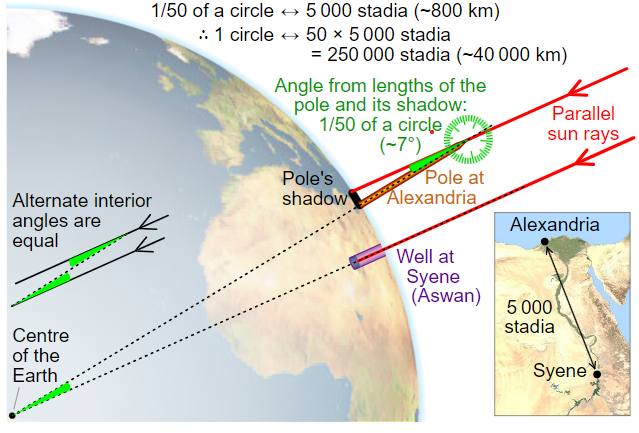
” … the arc in the bowl is found to be one-fiftieth of its proper circle. Therefore the distance from Syene to Alexandria must necessarily be one-fiftieth part of the great circle of the earth. And the said distance is 5000 stades; therefore the complete great circle measures 250,000 stades. Such is Eratosthenes‘ method.”


” Here we see the simple geometry of a sundial. The vertical h is shown for two examples: a 6ft (183cm) post and the height of one of the obelisks that still stands in Temple of Karnak, erected by Pharaoh Hatshepsut (c.1478 – 1458 B.C.) As we can see, the question of whether Eratosthenes would have noticed a shadow at Syene if he had carried out the observation is clearly yes. If Eratosthenes would have used a 183 cm staff or post to measure a shadow, he would have noticed a 1.17 cm shadow on the northern side of the hypothetical sundial.”
Or so goes the popular (myth) story …. YET:
“Form the information seen above, it is clear that Eratosthenes did not perform an observation or experiment at Syene to confirm that the city was under the North Tropic. Although many scholars have acknowledged this fact, to our awareness, none of them have calculated when the North Tropic was situated at the Latitude of Syene, nor have they taken into account Cleomedes’ margin of uncertainty in order to calculate a spectrum of time wherein the original observation was made. As we have shown, the time gives between 3750-1500 BC. This is the actual fact of science, but many questions arise from this piece of data. In the feedback we received from other scholars on this question, it has been proposed that Eratosthenes took for granted that Syene was under the Tropic, and that this information came to him through documents in the Library of Alexandria, or through “rumors” circulating at the time. It seems rather clear that the latter idea should be ruled out in favor of the first, not only because it seems the most reasonable in consideration of the volumes the library contained on a variety of sciences, but also because the Tropic had been displaced from Syene thousands of years before the time of Eratosthenes. If any oral tradition existed in Egypt regarding the lack of shadows on the day of North Solstice at Elephantine, it must have been 1300 years old by the time of Eratosthenes, and it is much more likely that such knowledge was preserved in writing. Everything indicates that the Greek geographer had access to ancient sources that provided the method he used and that was later related by Cleomedes, but the Obliquity of the Ecliptic and the chronology it provides forces us to acknowledge that both the method and the observations were originally carried out by the Ancient Egyptians between 3750-1500 BC,”
“Some have proposed that Eratosthenes did perform the experiment in Alexandria, and therefore used the angular shadow of a polos or gnomon to calculate the Polar Circumference of the Earth. Indeed, the thesis that the original method and observations were carried out by the Ancient Egyptians between 3750-1500 BC does not discard the possibility that Eratosthenes performed an observation at Alexandria, and then made his own estimate for the Earth’s circumference. But this theory presents us with the question of how Eratosthenes arrived at the measurement of 5000 stades between the latitudes of Syene and Alexandria. As we will see later, it is much more likely that the distance between Latitudes 24º 5’ – 31º 12’ N was measured by the Egyptians long before Eratosthenes time, and these “stades” are originally Egyptian units of measure. We also do not know how Eratosthenese knew that the Sun was at such a great distance from the Earth that it’s rays would fall parallel on the Earth as Cleomedes states. The fact that Cleomedes quotes Eratosthenes saying that Syene and Alexandria are on the same meridian is an error that indicates an incomplete understanding by Eratosthenes about the method in question, for it is not necessary for the locations to be on the same Longitude or E-W coordinate.”
Other Celestial Curiosities you Might Not have Noticed:
How many readers have noticed
how our Moon only touches her northernmost Full Moon rising point on the horizon once every 18 yrs…


* * * *
Feel free to copy while giving proper attribution: YucaLandia/Surviving Yucatan.
© Steven M. Fry
Read-on MacDuff . . .
 Surviving Yucatan
I never knew that about the moon. I watch it change its rising position every month, but never realized it falls into a pattern that would move it further and further north and south.
I understand that about the solar panels. Are used to do freelance solar design with panels to make them operable so they could tilt at least three different directions, one for winter, one for equinoxes, and one for summer.
Thanks Steve. I’ve marked my iCal with “Solar Noon”, annually going forward with these dates, to remind myself not to try to walk on the shady side of the street around noontime. ~eric. MeridaGOround.com
We are in Jalisco, not Merida, but I found this interesting. I wish you were writing “Surviving Jalisco” also!