

March 7, 2026
Have you ever wondered just what’s really going on off-shore … just beneath the waves?
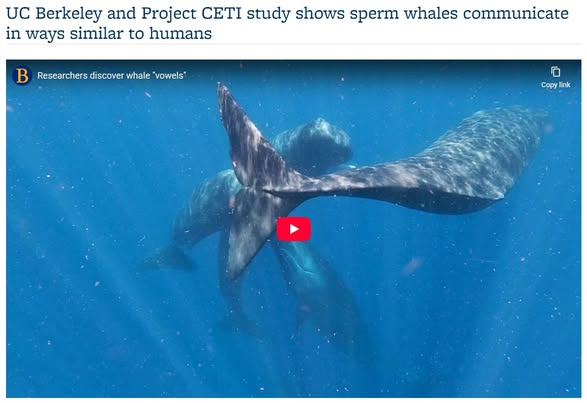
The international CETI program (Cetacean Translation Initiative)** … as a collaboration between Swedish scientists with their UC Berkeley colleagues ave been doing some pretty cool stuff, tracking & recording whales … and DECODING whale’s language.
UC Berkeley Linguistics Professor Gašper Beguš, the linguistics lead at Project CETI offers some insights:
“In the past, researchers thought of whale communication as a kind of morse code,”
“However, this paper shows that their calls are more like very, very slow vowels. This suggests a complexity that approaches human language.”
” (The) spectral properties (of whale languages) are highly structured, discretely distributed across codas*, and uttered in DIALOGUES “
* ” (Whale) Codas are on many levels analogous to human vowels and diphthongs and can be conceptualized in terms of the source-filter theory: vowel duration and pitch correspond to the number of clicks and their timing (traditional coda types), while spectral properties of clicks correspond to formants in human vowels. “
/
Whale Video …
https://youtu.be/eFbnYQI-Oa0
An AI Breakthrough:
Machine learning analyzed 8,000 hours of Hump-backed whale recordings from underwater microphones spanning three oceans. … CETI’s AI system identified recurring patterns … syntax rules … and even contextual variations similar to human language.
Specifically, whales use “phonemes” … combined into “words” that form “sentences” with identifiable meanings.
A phoneme is a voiced sound … the smallest unit of speech-sounds that distinguishes one word from another … like b and p in “bat” and “pat”. … English has approximately 44 unique phonemes (24 consonant and 20 vowel sounds).
The joint research shows that whale vowels feature the SAME vowel features (differing length, timing, frequency and trajectory characteristics) that mirror human language … and … In human speech, these differing/changing vowel-characteristics carry meaning. … so, it’s highly-likely that the same is true for Sperm whales … and Humpbacks … because, why would super-intelligent whales just randomly add so many specific vocal twists & vocal gymnastics, without having some meaning or purpose?
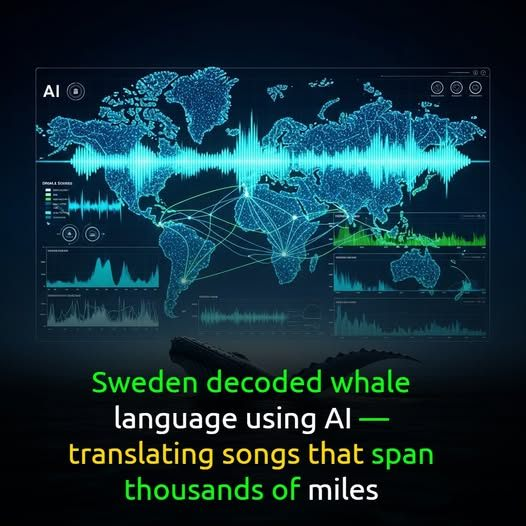
Here’s somewhat hokey FB meme (where they claim “Sweden”, versus the TRULY collaborative international CETI program) … as a promo, that downplays US scientists’ contributions. (???)
/
FURTHER Discoveries about Whale Information Exchanges:
~ Whales use warning calls about predators … transmitted over 1,000 km;
~ Whales send out individual mating advertisements containing the individual’s “name”;
(What about pickup lines ??)
~ They send navigational information about food sources; and
~ They SING …. cultural songs …. passed down through generations.
and yes, their songs have with regional variations.
~ Various whale populations also have distinct “accents” … akin to human dialects.
~ Individual whales remember their personal songs from year to year … and repeat them … suggesting cultural and possibly history-keeping.
~ Some song elements remain unchanged for decades => culture(?) that seem to be just like humans’ oral traditions …
“She’ll be comin’ round the mountain, when she comes …”
“She’ll be comin’ round the mountain … ~when she comes~”
~ Meanwhile other individual’s songs change from year to year … suggesting cultural evolution.
/
Finally … Animal Rights? … and Animal Law?
“We’re thinking deeply about what finding these human-like structures means for the legal rights of animals,” said Beguš.
“This paper prompts questions like, for example, What is Language? … Is there anything uniquely human about language, or is it just a continuum? … What does that mean for (human) law?”
“By questioning long-standing beliefs about animal communication, according to Project CETI, this research could pave the way toward RETHINKING the moral and legal distinctions separating humans and animals. “
🥰
/
Summary Article:
https://ls.berkeley.edu/news/uc-berkeley-and-project-ceti-study-shows-sperm-whales-communicate-ways-similar-humans
The actual scientific report:
https://pmc.ncbi.nlm.nih.gov/articles/PMC12594577/
Whale Video …
https://youtu.be/eFbnYQI-Oa0
Cheers,
Dr. Fry
* * * *
Feel free to copy while giving proper attribution: YucaLandia/Surviving Yucatan.
© Steven M. Fry
Read on, MacDuff.
 Surviving Yucatan
This is truly amazing! I have known that whales communicated, but this level of communication is pretty astounding. Now I love them even more.