
 Nov. 13, 2023
The No Fun Group is roaming our snacking landscapes again, pointing out that almost all chocolate contains some Cadmium & Lead, yet many of our beloved DARK chocolate brands (like HERSHEY’s) are contaminated with unhealthy levels of Cadmium & Lead.
Who knew … that just like tuna … we really need to limit our chocolate consumption
… especially in children and pregnant moms … 😦
Fortunately … Even though all milk chocolate has lower levels, (aka just “some” toxic Cadmium and some toxic Lead) … realize that any level of toxic Lead & Cadmium that we consume, deposits in our bones and accumulates for decades … and is only removed from our bodies slowly by hair growth and fingernail growth.
This means that just like we should limit our children’s & pregnant Mom’s tuna intake to just once or twice a month, we should also limit our kid’s chocolate intake to JUST milk chocolate, and then only as a *treat* … not as a daily staple. 😦
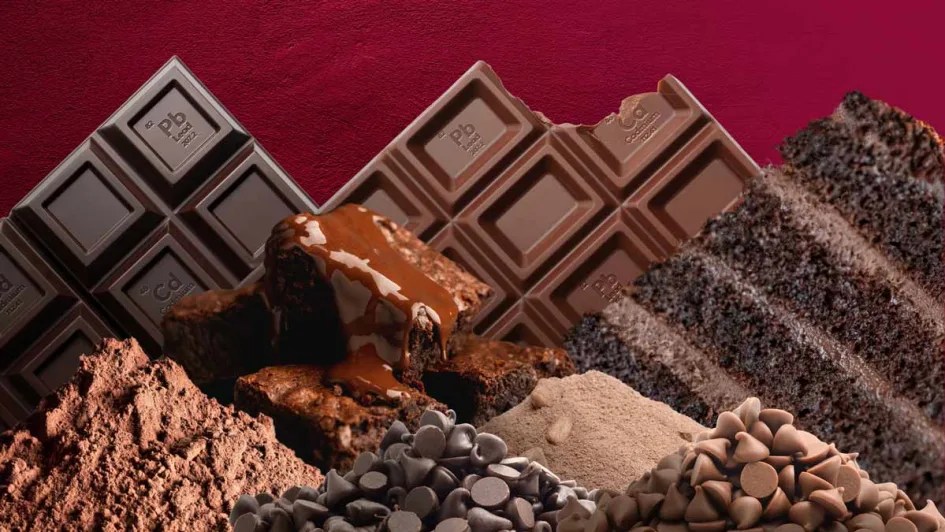
From Consumer Reports latest issue:
” As expected, dark chocolates tended to have higher levels of heavy metals and milk chocolate lower. “But every product we tested had detectable amounts of lead and cadmium,” says James E. Rogers, PhD, director and acting head of product safety testing at CR. “Sixteen of the 48 products had amounts above CR’s levels of concern for at least one of the heavy metals—in some cases more than twice our limit—but we did find safer options in each category of chocolate products.” “
The heavy metals Lead and Cadmium get into cocoa from the soil and from dust-contamination during cacao bean processing. Cacao plants take up cadmium directly from the soil, with volcanic soils being the biggest problem. Plants absorb some lead through the roots from soil solutions, entering our food chain, yet the bigger source of Lead in chocolate comes from dust depositing on the cocoa beans after harvest. This means that chocolate producers CAN reduce the toxic Lead levels in our chocolates, IF they simply wash the cacao beans thoroughly.
This is enough of an issue, that there’s now a formal petition to HERSHEY’s to get them to take a few measures to reduce the toxic Lead & Cadmium in their products:
https://action.consumerreports.org/cro-20231025-hersheychocolate2
Why does Milk Chocolate have smaller amounts of Toxic Lead & Toxic Cadmium?
Toxic Lead & Cadmium are both found in the cocoa solids and cocoa butter, key ingredients in cacao. Milk chocolate has less Lead & Cadmium because it has much lower cocoa solids & cocoa butter levels. Meanwhile, products rich in cocoa solids, like dark chocolate and cocoa powder, hot-chocolate mixes, & cake-brownie mixes tend to be higher in heavy metals.
Where does that leave us?
Because toxic Lead (Pb) and Cadmium accumulate in our bodies throughout our lifetimes, and because toxic Lead causes Central Nervous System damage … Kidney damage, High Blood Pressure, & Cardiovascular problems .. and because Cadmium is a potent cancer causing agent, makes our bones brittle, and causes Kidney damage … it is especially important to limit both Cadmium and Lead ingestion-consumption by children and pregnant Moms ~ and ~ focus on milk chocolate as just a *treat* for kids.
IOW … For kids: Use milk chocolate … administered as a treat … and avoid cocoa powder and most dark chocolate products.
Using 4 oz samples, Consumer Reports testing found just 6 dark chocolate products with acceptable levels (for ADULTS) of toxic Lead & Cadmium:
Ghirardelli Intense Dark Chocolate 86% Cacao,
Ghirardelli Intense Dark Chocolate Twilight Delight 72% Cacao,
Mast Organic Dark Chocolate 80% Cocoa,
Taza Chocolate Organic Deliciously Dark Chocolate 70% Cacao, and
Valrhona Abinao Dark Chocolate 85% Cacao.
Using 4 oz samples, Consumer Reports testing found 4 dark chocolate products with very–unacceptable levels (for EVERYONE) of toxic Lead & Cadmium:
Divine 85% Exquisitely Smooth Dark Chocolate
Evolved Signature Dark 72% Cacao Chocolate Bar
Perugina 70% Premium Dark Chocolate and
Perugina 85% Premium Dark Chocolate
Consumer Reports test results for MILK CHOCOLATE were much more encouraging:

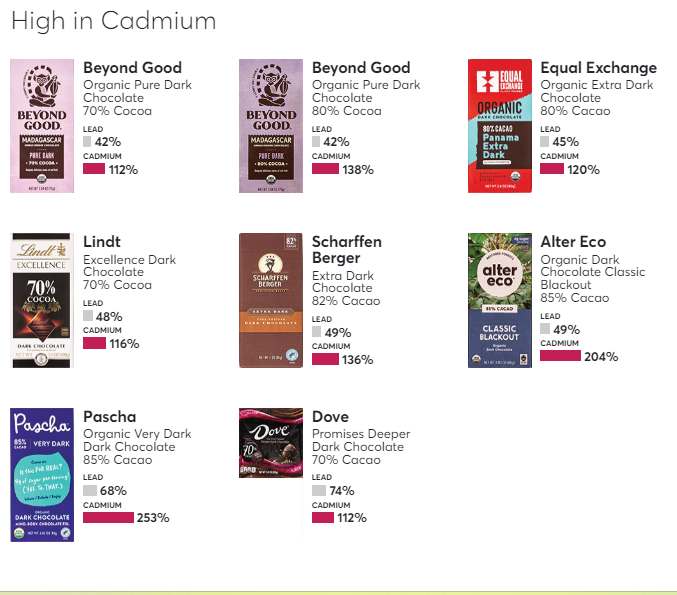
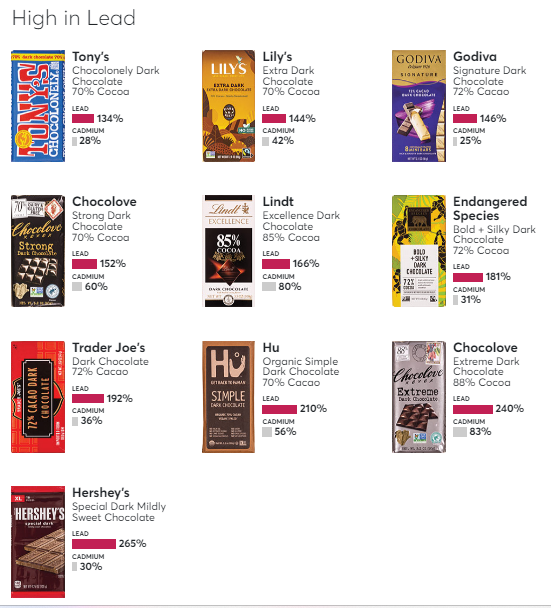
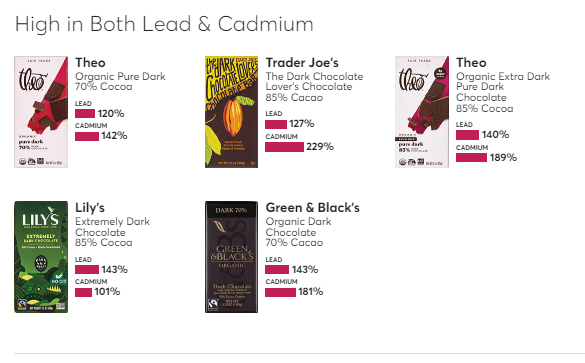
On to Chocolate Chips!
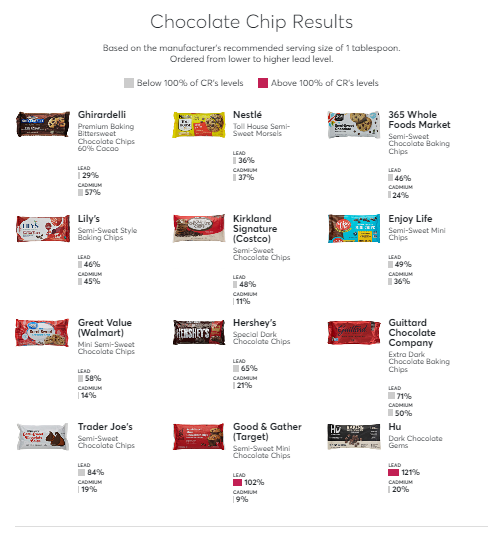
None of the chocolate chip brands (12 products tested) had high levels of cadmium. … Only two: “Hu Dark Chocolate Gems and Good & Gather (Target) Semi-Sweet Mini Chocolate Chips” were over CR’s limit for safe lead consumption by ADULTS.
Cocoa Powder
Cocoa powder is almost all cocoa solids, so you might expect that most would be too high in lead and cadmium, even in small amounts. But none of those we tested were high in cadmium, and only two had high levels of lead.
Most of the cocoa powders in our tests were natural-style—the kind most commonly available in the U.S.—and of those, a serving (1 tablespoon) of Hershey’s Cocoa Naturally Unsweetened 100% Cacao exceeded our lead limit.
Droste Cacao Powder was the only Dutch processed cocoa in our tests. This type of cocoa is alkalized to give it a less bitter taste. It was also the highest in lead of any product in our tests, supplying 324 percent of CR’s limit.
The best cocoa powder overall was Navitas Organics Organic Cacao Powder, which reached 77 percent of CR’s lead limit and 17 percent of the cadmium limit. Navitas has a third party test all finished products for heavy metals to ensure low levels, according to the company website.

Hot Chocolate Mixes
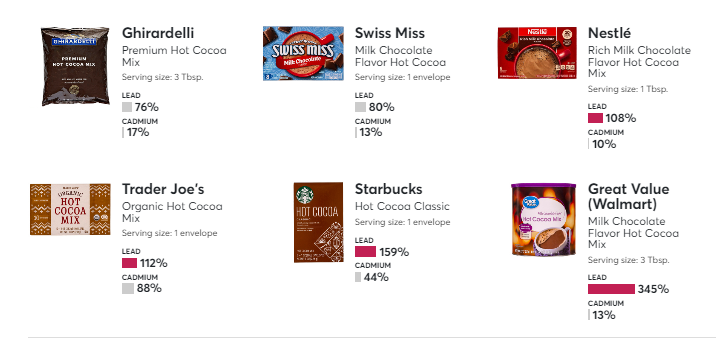
These mixes contain cocoa powder plus sugar and other ingredients, so we expected that they would be relatively low in lead and cadmium. That’s not what we found. Four of the six mixes we tested exceeded our lead limit: Great Value (Walmart) Milk Chocolate Flavor Hot Cocoa Mix, had the highest levels, with mixes from Trader Joe’s and Nestlé (which also makes hot chocolate mix for Starbucks), above CR’s cutoff.
The Nestlé spokesperson said that the company stands by the safety of its products and that it works with its “suppliers on an ongoing basis to closely monitor and minimize the presence of these substances in our foods as much as possible.” Other makers of hot chocolate with high levels of lead did not respond to requests for comment.
Ordered from lower to higher lead level.
Brownie and Cake Mixes
These products fared well overall in our tests. None were high in cadmium, and just one brownie mix and two cake mixes exceeded CR’s lead limits—one by quite a bit. One serving of Bob’s Red Mill Gluten Free Chocolate Cake Mix had 216 percent. The heavy metal levels refer to the amounts of the mix that are in one serving of the finished cake or brownie. (We list the number of servings each mix makes in the charts below.)
However, the serving sizes are small. For instance, Duncan Hines Devil’s Food Cake mix makes a cake that the manufacturer says will serve 10. The company’s Double Fudge Brownie mix makes 20 servings. If your cake or brownie portions are more generous, keep in mind that you’ll be getting more lead and cadmium than we list here.
Bob’s Red Mill, Simple Mills, and Ghirardelli did not respond to requests for comment.
Ordered from lower to higher lead level.


From Consumer Reports:
“Making Chocolate Safer
Since any intake of heavy metals can be harmful over time, it’s important that products contain the lowest amount possible. There are ways for manufacturers to reduce the heavy metals in their products—such as sourcing chocolate from areas that have low levels of cadmium in the soil, and making improvements in cocoa harvesting, processing, and cleaning procedures.
CR reached out to an industry trade group as well as the Food and Drug Administration for comment.
“Chocolate and cocoa are safe to eat and can be enjoyed as treats, as they have been for centuries,” says Christopher Gindlesperger, senior vice president of public affairs and communications for the National Confectioners Association, a candy industry group. “Food safety and product quality remain our highest priorities, and we remain dedicated to being transparent and socially responsible.”
The Food and Drug Administration told CR that “While the presence of cadmium and lead in chocolate has been the subject of considerable media attention, experts from around the world have found that chocolate is a minor source of exposure to these contaminants internationally.” And the agency added that “ all food manufacturers and processors are responsible for ensuring the safety of their food.”
Our results, however, show that some companies may be doing a better job of keeping metals out of their products than others. That’s true even for dark chocolate and cocoa powders. “In general, products with higher cocoa content tend to have higher levels of metals, but not always,” says Eric Boring, PhD, a CR chemist who oversaw our chocolate tests. “There’s enough variation in the lead levels within each category of foods that it’s clear factors other than cocoa content affect lead levels, and that means manufacturers have the ability to reduce the heavy metals in their products to the lowest levels possible.”
For example, if Navitas Organic Cacao can be lower in lead, Boring says, why can’t Hershey’s make a cocoa powder that is lower in the heavy metal, too?
Brian Ronholm, director of food policy at CR, adds that “Earlier this year, a Hershey executive stated that the company continues to look for ways to remove more of the metals through additional cleaning and alternate sourcing. We would like for them to honor that commitment.”
“Since the metals occur naturally in soil, it may seem that it would be difficult to reduce contamination, but there are some steps that chocolate makers can take to make their products safer,” Ronholm says. These include sourcing from areas with lower levels and mixing beans from different areas to ensure that the final product has lower levels. Producers could also test lots of cocoa to identify problem areas and reject particularly contaminated lots, he says.
Making Healthier Choices
• As much as possible, it makes sense to try to avoid heavy metals in your diet—but that doesn’t mean you should never eat chocolate.
• Kids and pregnant people should consume dark chocolate sparingly, if at all, because heavy metals pose the highest risk to young children and developing babies. And if you do eat it, pick products that our tests showed to have lower levels of heavy metals. When consuming other cocoa-containing items—like hot chocolate or brownies—it may be best to limit these to not every day, and also choose products lower in heavy metals. And, of course, you should limit how much you eat other foods that tend to be high in heavy metals, such as rice and rice products, carrots, and sweet potatoes.
• Milk chocolate can be a fine alternative for those who want to limit heavy metal exposure, but don’t treat it as a health food—it’s packed with more sugar than dark chocolate, and should still be consumed in moderation.
• For other adults who want to eat dark chocolate, occasional consumption won’t necessarily expose you to extremely high levels of heavy metals. But as much as possible, try to be aware of potential metal exposure from multiple sources. For more tips, see our previous article on metals in chocolate.
• When consuming hot chocolate, brownies, chocolate cake, and other cocoa-containing products, know that they can contribute to your overall heavy metal burden. As with other types of chocolate, these are best consumed in moderation. “
Sources:
https://www.consumerreports.org/health/food-safety/a-third-of-chocolate-products-are-high-in-heavy-metals-a4844566398/
https://www.consumerreports.org/health/food-safety/lead-and-cadmium-in-dark-chocolate-a8480295550/
https://www.cdc.gov/biomonitoring/Cadmium_FactSheet.html#:~:text=Breathing%20high%20levels%20of%20cadmium,considered%20a%20cancer%2Dcausing%20agent.
https://www.who.int/news-room/fact-sheets/detail/lead-poisoning-and-health#:~:text=Lead%20also%20causes%20long%2Dterm,birth%20and%20low%20birth%20weight.
Cheers,
Dr. Steven M. Fry
* * * * * * *
Feel free to copy any of our materials, yet please also give appropriate credit, by citing Yucalandia.com.
Read-on MacDuff !
 Surviving Yucatan