

Feb. 16, 2026
Local Yucatecan Contexts on Valentine’s Day:**
As we have just passed through another Valentine’s Day, I’m struck by how different cultures view love … as seen through their languaging of love:
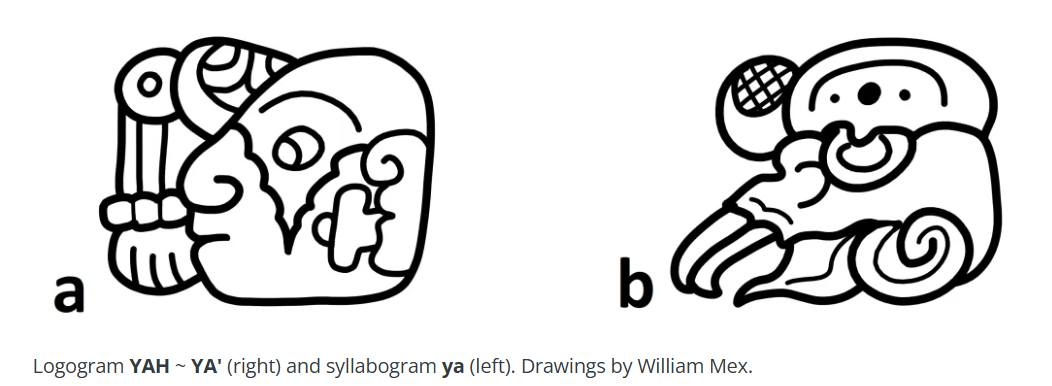
Consider how both modern and ancient Yucatec Maya people’s languaged love … “yah” … as various forms of pain. 🤣🥰🤣
The 1500’s Motul Mayan Calepino describes “yah” as “to love” … or alternately as “a beloved thing” … [1]
The Calepino also includes:
“Yahba”= to love oneself,
“Yahbil” = beloved and esteemed or “a gifted and cherished thing”,
and
“Yahcunah”/”Yacuntah” = is ‘to love’ … but with a twist .. .where “yahcuntah hanal” means … “to hide and keep one’s food so as not to give it to another” … [2] . 🤣
Yucatec Maya’s “yah” is also recorded as meaning:
“a small, non-dangerous sore or wound already rotting” … and
~ “a sore thing”,
~ “something that hurts and stings”
~ “pain and stinging”
~ “to have pain (or pains) like this”
~ “to be tired of pains or illness”
~ “to feel something very much”
~ “a dangerous thing”
~ “a difficult and troublesome thing”
~ “a serious thing” …
and (finally)
~ “evil or evils of sorrow or work or misery; woe, misfortune or adverse circumstances” … “fatigue and harm. … [3]
AND YES … the meaning of that 1 word for “love” = “yah” depends on the context.
…
The derivatives of “yah” are similarly complicated:
Where “yaah” is “adangerous sore, “evil and harm, and illness in general”, “poison, great evil” … [4] .
More of the Mayan Love Language:
~ “Yaahezah” = “to wound or damage or INFECT soul or body”
~ “Yahil (or “u yahil”) = “roughness, strength, hardness, and gravity and rigor of something” … “something rough, strong, serious and painful” … and
~ “Yyahili” = “with work” [5] .
~ “Yahtzil” = “the mercy, alms, charity and favor that is received”, “beloved thing”, “something painful, laborious or difficult, that is done with difficulty”. [6]
/
Yet … maybe that 16’th Century writer had his own personal biases??
So … Let’s move on to a different Yucated Maya source, the “Maya Than Vocabulary” 16’th & 17’th century compilation of Maya words … from the Maní region:
“Yahil” & “Yahcunah” = “Charity, out of love”,
“Yahcunanben” & “Yahcunanbentzil” = “a kind thing”, and
“Yahbil” & “Yahcunanbil” = “a beloved thing” … [7] .
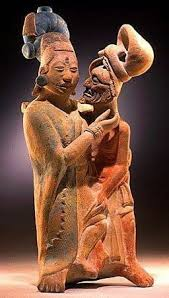
And yes, despite some silly Facebook attributions of this classic Maya image, as a supposed “The
Embracing Couple– a Pre-Columbian Maya terracotta figurine (circa 650–800 AD) that depicts an old man in a loving embrace with a younger woman.” … Instead this is the Classic Maya image of the (pervry?) old Maya God of the Sky (and Creator God) Itzamná … feeling up the nubile young Moon goddess Ixchel … Doubters are invited to notice the position of Itzamná’s left hand.
…
Branching out from ~romantic~ love, you can add:
~ “Yahcunah” = non amorous (non erotic love) to love a family member ..
… as in the expression “Yahma in yum.” … “I love my father very much” …
or
“Yah in yum toon.” … “We love my father like this”
and also the phrase
“Mehenil yahcunah.” … “I love you like a brother” .. “filial love” [8] .
/
The same themes exist in modern Yucatec Maya … where “yaj” means painful, and “yaaj” = pain …
These exist in common phrases like:
“Yaaj tin wóol.” … “I’m sorry” …
and the modern:
“Yaajkuns” = “to cause pain” or “to love” and
“Yaajkunaj” = “love” (n – subject),
and finally
“Yaakunt” = “to love” (v) … [7] .
~ ~ ~ ~
**Where this may all seem a bit jarring … remember that Yucatec Maya ~sadly~ tragically, have the highest suicide rates of all native groups across Mexico …
….
So … for people wanting to learn some Yucatec Maya … There you have it!
~ ~ ~ ~
Language – Translation References:
[1] Acuña 2001:282 and 283.
[2] Acuña 2001:284
[3] Acuña 2001:281
[4] Acuña 2001:284
[5] Acuña 2001:285. The suffix -ez is a causative and the suffix -il forms the abstract term of the noun.
[6] Acuña 2001:292 and 293
[7] Acuña 1993:90 and 172
* * * *
Feel free to copy while giving proper attribution: YucaLandia/Surviving Yucatan.
© Steven M. Fry
Read on, MacDuff.
 Surviving Yucatan