

June 26, 2025
With all the people struggling to live in the USA, lots of North of the Border folks are seriously considering moving to Mexico.
These earnest gringos/gringas are cautioned by Social Media ~ old-fart foreigners-in-Mexico~ that they should WAIT to move here, and come here ONLY …
… “When you learn Spanish … FIRST ” ….
That approach sounds reasonable, yet … the current President may already be out of office, if you wait to come to Mexico before speaking Spanish. … Spanish is quite complex … especially with all the Arabic-rooted words* … 14 verb tenses** … and all the peculiarities to Mexican Spanish and especially Yucatecan Spanish.
Are you ready to try?
Here are some practical shortcuts to learning Spanish:
Consider learning the present, past and future tenses of only the commonly used irregular verbs: ser, estar and ir.*
Next … Learn ~just~ the present tenses of other common verbs … and then for irregular verbs, talk like a China-man – using the present tense verb form combined with “today” … “tomorrow” … “yesterday”:
“You go … NOW !” … “You go TODAY !” … “You go … TOMORROW !”
… You go … YESTERDAY!“
Only then … learn the other verbs’ endings for ONLY past and future for ONLY regular verbs.
To conjugate regular Spanish verbs, identify the verb’s ending (-ar, -er, or -ir) and remove it to find the stem/base word. Then, add the appropriate ending based on the subject, pronoun and tense. For regular verbs, the endings follow predictable patterns.
Regular Verb Conjugation:
Infinitive: All Spanish verbs end in -ar, -er, or -ir.
Stem: The stem is the part of the verb before the infinitive ending (e.g., in “hablar,” the stem is “habl-“).
Conjugation:
-ar verbs: Remove the “-ar” … and add -o, -as, -a, -amos, -áis, -an.
-er verbs: Remove the “-er” … and add -o, -es, -e, -emos, -éis, -en.
-ir verbs: Remove the “-ir” … and add -o, -es, -e, -imos, -ís, -en.
Example:
Comer => stem/base = Com-
Yo como (I eat) … Yo comí (I ate … ) … Comeré queso mañana. (I will eat cheese tomorrow.) …
Hablar (to speak):
Yo hablo, tú hablas, él/ella/usted habla, nosotros/as hablamos, ellos/ellas/ustedes hablan.
Comer -full version (to eat):
Yo como, tú comes, él/ella/usted come, nosotros/as comemos, ellos/ellas/ustedes comen.
*Except for learning the irregular verb tenses for estar, ser and ir … I would just treat all other verbs as if they were regular verbs – and just say them as 3 tenses (like English’s 3 tenses – past, present & future) …
Doubters – and people who love to argue, can consider the complexity of an adult foreigner learning just the very commonly used verb hacer. (See below)
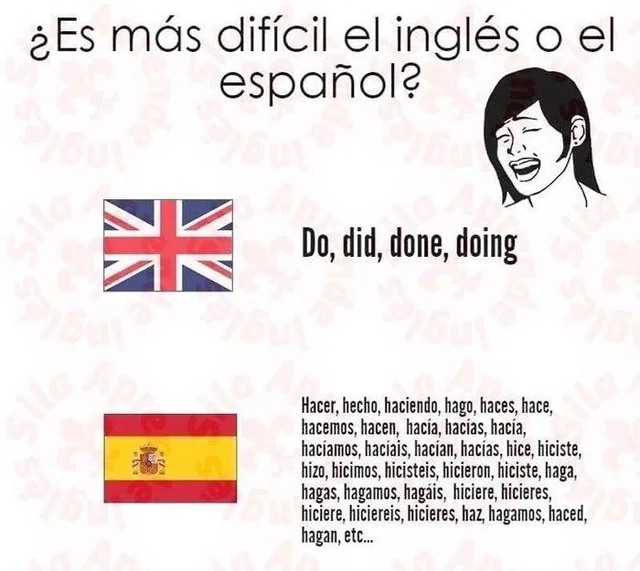
Next:
~ Recognize all the words in English that have 2 forms … Romance based and Teutonic (Germanic) based:
Example: Subterranean & underground … The more elegant form will be Romance based … Choose that one, and say it with a Spanish accent…
Skip “Underground” and go to Subterranean … which phoenetically becomes soob-tehr-rahneo …
Flower – Bloom … Flower is obviously the Romance version => Flor …
AND
Be SURE to learn the gender of each noun WHEN you learn it.
Raya = a scratch (in the paint) or a stripe
Rayo = Lightning bolt
Olla = pot (for cooking)
Hoyo= hole (in the ground) … TRICKY because the “H” is silent, and the “Y” sounds just like the “LL” …
.
Are readers starting to understand why waiting in the USA until you “can speak Spanish” … likely means waiting until after the current President will be out of office. 🤣🥰🤣
Next:
Learn the common FALSE COGNATES – False Friends – that sound almost exactly the same in Spanish and English … but have very different meanings.
Embarazada in Yucatecan Spanish sounds just like embarassed – but Embarazada means pregnant … meanwhile “vergüenza” means embarrassed.
There are at least 50 or so FALSE Cognates worth knowing – because you will confuse Spanish speakers by using the wrong word … See the website below for the Internet’s biggest list of Spanish-English / English-Spanish false cognates.
.
Next:
Learn that there are often 2 words in Spanish for the same thing … Betabel & remolacha …. are both “beet” … So when you learn just 1 word for something in Spanish – then Spanish speakers will sound intelligible when they use the other word.
Then … SKIP LEARNING formal Spanish from Spain – because the paltry 46 million Spaniards speak REALLY WEIRD Spanish … versus the 450 MILLION Americans speaking “American Spanish” **… 

Next:
Learn to recognize all the peculiar Arabic-Moorish words that occupy 10% of Spanish words … starting with the ones that start with A … or Al … because… your Romance Language-Germanic Language tuned brain will likely have NO REFERENCE points for them – yet those Arabic words in Spanish are super common => 10% of common Spanish words.
Why? …Spain is a VERY YOUNG country (just 500 yrs old) … while “Spain” was Arabic-Moorish (Arabe-Morro) for a much longer 700 years:
Examples:
Almuerzo (Al-muerzo) = Lunch … at 2 pm
Almohada (Al-mohada) = Pillow
Alfombra (Al-fombra) = Carpet
Aduana (A-duana) = Customs (like at a border crossing)
Alcalde (Al-calde) = Mayor (of a city)
Algodón = Cotton
Azúcar = Sugar comes from the Arabic “as-sukkar”.
Aceite = Oil (for cooking)
Arroz = Rice
Alacrán = Scorpion => an issue here in your bedroom in Yucatan
Azafrán: Saffron
Ojalá = Hopefully … God willing …
Alcohol (Al-cohol) … and Algebra (Al-gebra) are easy …
YET, there are ~merely~ 10,000 Arabic/Moorish words in Spanish …

.
all of which pushes back “moving to Mexico” even farther … by coming “only after learning Spanish” …

Finally …
*American Spanish (what’s spoken in the Americas) … has so many local idioms, so many local colloquialisms … and so many Native American words … that learning “proper” formal Spanish from Spain … will leave you badly hobbled here in the Americas.
Quick … When at a restaurant … What’s a straw … here in Mexico? … “Popote” !
from the Nahuatl word for reed.
Meanwhile Spaniards say “pajita” …
It’s “pitillo” in Colombia and Venezuela
“Cañita” is the preferred word in Peru.
… with “bombilla,” “calimete,” “carrizo,” “pajilla,” and “sorbete” thrown in for fun across the Americas …
plus Yucatecan expressions … like huatch/wach … for “outsiders”.
FINALLY … Yucatecan Spanish is weird, because it has so many Mayan words … and so many Mayan people speak/learn Spanish as a second language … that even Mexicans often CANNOT understand local Yucatecans speaking Spanish .. because our “s” and “z” sound exactly the same … “b” and “v” are pronounced the same … and many Yucatecans’ spelling is “very-different” from Spain … Wero/Wera …
LOL
Cheers …
Dr. Steven M. Fry
* * * *
Feel free to copy while giving proper attribution: YucaLandia/Surviving Yucatan.
© Steven M. Fry
Read on, MacDuff.
 Surviving Yucatan
I took some Spanish classes and found them helpful. But I learned most of my Spanish by traveling in Mexico.
I attempted, poorly, to talk to people. They were kind, patient, and friendly. I had a friend in Mexico who was willing to help me learn some Spanish in exchange for teaching her some English. We became fabulous friends, and both of our second languages were enhanced.
I don’t live in Mexico. At this point, I wish I did. For me, it is more about my age than my language ability. I’m nearing 80 and don’t feel like I have the energy to do everything I would have to do to move to a foreign country.
You offered some fabulous suggestions, and anyone who wants to move there should just do it, and simply start talking to people. Most people in Mexico are kind and patient with those who try to use the language.