Update on Aduana Mexico’s Policy on Foreign-Plated Car Permits

March 4, 2013 Update
There is a report out of San Miguel Allende (SMA) that the US “Consul”, Edward Clancy,  has spoken with the head of Aduana about the current issues of foreign-plated cars in Mexico owned by Americans using Temporary Import Permits (TIPs).

Personal email received today by Yucalandia directly from Consular Agent Edward Clancy DENIES ever talking with the “head of Aduana”.

Yucalandia readers should IGNORE any reports about:
   ~ False Report~ If your car was legal before you changed to either the INM Residente Temporal or Residente Permanente cards,   then the head of Aduana says that your foreign-plated car and your Aduana TIP are still valid,   as long as you have a valid INM permit.    ~ False Report~
Happy Trails,
steve

* * * * * * *
Feel free to copy while giving proper attribution: YucaLandia/Surviving Yucatan.
© Steven M. Fry

Read on, MacDuff !

Posted in Uncategorized | 18 Comments

Proposal to Nationalize Almost Any Vehicle in Mexico

In the ongoing saga of “Nationalizing Almost any Vehicle in Mexico”, here is TioCorp’s latest official reply to requests for help importing vehicles.

Key Details:
~ They want a (non-refundable) prepayment of 50% of up-front money just to start the process.
~ No Inmigrante (FM3) and Residente Temporal permit holders are disqualified from using the Amparo.
~ TioCorp specifically “assume(s) no responsibility for the legality of your vehicle.”
~ The legality of your importation of the vehicle depends solely on the unnamed Customs Broker that Tiocorp chooses to use.
~ TioCorp refuses to release any details on the Amparo, saying:
The information was provided by the import agent who filed suit for the amparo and we do not have access to the court transcripts or other documents. He considers this to be privileged information which provides him with competitive advantage.

Further: TioCorp puts the following disclaimer on every page:
“The legal responsibility to process your application to import your vehicle is that of the Licensed Import Agent based upon the documents and information you have provided. We act as a sales agent only and cannot guarantee the legality of your vehicle once processed. That is the legal responsibility of the Licensed Import Agent and you as the declared legal owner.”

The bolding is my addition.. . .   Continue reading here…

*    *    *    *    *    *    *
Read the full Article at:
Proposal to Nationalize Almost Any Vehicle in Mexico

*     *     *     *     *     *     *
Feel free to copy while giving proper attribution: YucaLandia/Surviving Yucatan.
© Steven M. Fry

Read on, MacDuff.

Posted in Uncategorized | 7 Comments

Current Aduana Car Import Rules Made Obsolete by INM’s New Residency Categories

There have been tons of  rumors,   suppositions   and misinformation  flying around on expat forums and expat blogs about what people think are the current Aduana rules for temporarily imported foreign-plated cars,   a.k.a  “TIP” (Temporary Import Permit)  cars.

Here at Yucalandia,  we like  facts   supported by the   official rules  and  laws.   Using that basis,  let’s evaluate what is written in the  current law  and   official rules:
First:   There are no Aduana rules or law that specifically cover how to   issue  or  renew   Permisos de Importación Temporal de Vehículos  for foreigners with either  Residente Temporal  or   Residente Permanente  IMN residency permits.   ~  Zip / Zero / Nada ~

In the absence of any published law or rules, each local Aduana office is currently doing what they think makes sense  –  likely as decided by their local director.

Second,  . . .   Continue reading here…

We have to wait until Aduana actually publishes something official.

Let’s all hope that Aduana comes out soon with official policies that work.
Happy Trails, steve
*    *    *    *    *    *    *
Read the full Article at: Current Aduana Car Import Rules Made Obsolete by INM’s New Residency Categories

*     *     *     *     *     *     *
Feel free to copy while giving proper attribution: YucaLandia/Surviving Yucatan.
© Steven M. Fry

Read on, MacDuff.

Posted in Uncategorized | 6 Comments

Tax Issues for Americans Living and Working in Mexico – A Redux for 2012

Happy Dead Presidents Day !
In honoring the memories of Mssrs. Lincoln, Jackson, Washington et al, it gets one thinking about who they were, how they were portrayed … and   are portrayed on the US currency.

Which leads my wandering mind to the Benjamins,    and how it is that time of year again. The time of year when our banks, employers, mutual fund companies  send us notices of our income from last year,   which allows us to pay our annual tribute to the State and Federal Governments.

Brave readers   who venture into reader’s Comments on other articles  have noticed that there have been a spate of questions about tax issues for expats living  and working in Mexico.   This year’s questions have taken on more specific and detailed forms than ever, even to the level of requesting specific advice about their particular situations.   scary, nu ?

As a frequent filer since age 9,   I have done tax returns for friends, neighbors, fellow grad students, co-workers, alien friends (a.k.a. resident aliens from Mexico), family members, and for parts of 3 different businesses.    Yet,  even after living here for 7 years, I never got around to reading the US-Mexico Tax Treaty of 1993,   since our returns have been relatively simple.

Anyway,  getting back on point,  several Yucatan readers have asked some particularly good questions that I thought I knew the answers to,    but for which I had no/zip/zero/nada references   –  just the partial remembrances of past tax and  IRS stories from  talented friends who have worked and lived overseas for decades.

Ready to go down the rabbit hole?    (or through the looking glass…)
It’s time to roll up our sleeves and tackle the US-Mexico Tax Treaty – 1993. …. Continue reading…

* * * * * * *
Readers who want to read the full Article can go to:   Tax Issues for Americans Living and Working in Mexico – A Redux for 2012

*******
For readers with US Tax obligations:   Yucalandia has a growing body of US IRS information in several articles:

~ Capital Gains Taxes on Mexican Properties
~ Income Tax Liabilities in Mexico
~ Fideicomisos and FATCA: US – Mexico Agreement on FATCA Reporting Requirements

~ IRS Reporting Requirements for Mexico: Fideicomisos / Mexican Land trusts
~ FBAR’s and Fideicomisos: To File or Not to File, That is the Question ,
~ US Income Tax Filing Information for Ex-Pats
~ Tax Issues for Americans and Other Expats Living in Mexico
~ Updated 2011 IRS Requirements: Foreign Account Tax Compliance Act (FATCA)
* * * * * * *
Feel free to copy while giving proper attribution: YucaLandia/Surviving Yucatan.
© Steven M. Fry

Read on, MacDuff.

Posted in Uncategorized | 3 Comments

Aduana Proposal to Allow Existing Foreign-Plated “TIP” Cars to be Permanently Imported ?

In the comments on our Importing and Driving a Car in Mexico: A reader, Don Saigle, posted this interesting report based on what he heard at a joint INM / SAT presentation today (2/13/2013):

Attended presentation today by INM and SAT in Nuevo Vallarta.

IF I heard thing correctly, Aduana has totally disconnected the TIP issues from resident status ( temp and/or permenant ).   (Future) Foreign plated vehicles can only be in the country for a max. of 180 days and only on a tourist visa status.    Those that have foreign plated vehicle that wish to leave them in country,    have to contact a customs broker to have the vehicle ‘naturalized’.     Has anyone else heard this?

*    *    *    *    *    *   *
More details on Importing Cars into Mexico and Driving in Mexico can be found at our main article on cars : Importing & Driving a Car in Mexico

Feel free to copy while giving proper attribution: YucaLandia/Surviving Yucatan.
© Steven M. Fry

Posted in Uncategorized | 14 Comments

Temporary Opportunity to Permanently Import a Car Into Mexico

Check out this site for a special temporary program that may help you out with Permanently Importing your vehicle….
Importing During an Amparo . THIS IS A TEMPORARY WINDOW OF OPPORTUNITY for 2 border crossings…   Amparos are similar to temporary restraining orders issued by US Judges – dealing with specific issues and existing only temporarily;.

This is not a recommendation to  use Tiocorp.  It is a simple referral to a temporary program that allows special importation conditions at 2 different border crossings.

More details on Importing Cars into Mexico and Driving in Mexico can be found at our main article on cars :  Importing & Driving a Car in Mexico

Feel free to copy while giving proper attribution: YucaLandia/Surviving Yucatan.
© Steven M. Fry

Posted in Uncategorized | 7 Comments

Updated Information on the Higher Liability Limits for Mexican Insurance

Feb. 5, 2013 Update:
The underwriters ABA Seguros, ACE Seguros, and GNP Seguros have agreed to honor the new (approximate) $300,000 US Dollars of Liability Limits for Deaths on all currently in-force vehicle policies until expiration, at no additional costs.

http://blog.mexpro.com/mexico-insurance-alert-radical-change-to-mexico-liability-laws
* * * * * * *
Feel free to copy while giving proper attribution: YucaLandia/Surviving Yucatan.
© Steven M. Fry

Posted in Uncategorized | Leave a comment

Updated Insurance Auto Coverage Limits for Mexico

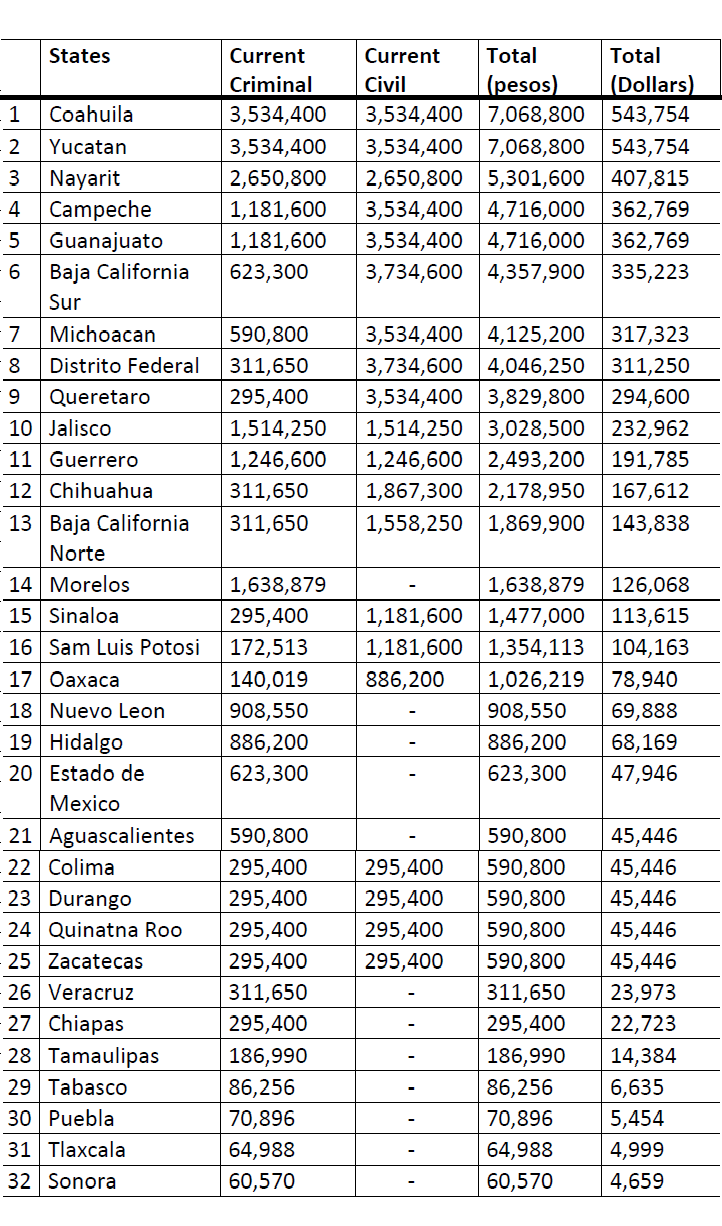
The Mexican government made changes to the Labor Law in 2012, which included a clause that increased the government established limits for the value of a human life, in case of accidental death, with the changes taking effect on February 4, 2013. A good friend posted the following information and table of values on Mexconnect today:

“This is the exact notice I received from my insurance company.”
“IMPACT OF CODE 502 REFORM ON MEXICO STATES AND YOUR ACE AND MAPFRE POLICIES”
“In December 2012, the Mexican government announced new reforms to the Labor Law in Mexico (Article 502). The Labor Law (Article 502) is used as the basis to compute limits to indemnify a person when someone dies in an accident. This caught the Mexican Insurers by surprise, as little notice or input was provided or requested of the Insurance Industry prior to the change. For many years, the indemnity limit was based on 730 days (Approximately 2 years) of minimum wage making $10,000-$20,000 a typical claim paid in any fatality.

Now, the time a dependent must be compensated has increased to 5,000 days.

Depending on the location of the accident, this may increase your financial exposure in Mexico to any at-fault auto accident which results in a fatality. Many Mexico states interpret Federal Laws themselves and create their own civil and criminal laws. Attached is a chart that shows the indemnity limits of the different states and how these states will apply them to their particular state.”

New Insurance Limit Requirements For Mexico

*      *     *     *    *     *     *
Insurance companies are allowing clients to increase their Liability Limits on their auto policies to cover the new liabilities for modest premium increases. It is worth noting that Yucatan has especially high liability limits, requiring additional riders to our policies for most people living here.

*     *     *     *     *     *     *
Feel free to copy while giving proper attribution: YucaLandia/Surviving Yucatan.
© Steven M. Fry

Posted in Uncategorized | 11 Comments

Advantages & Disadvantages of Residente Permanente and Residente Temporal Immigration Permits for Mexico

Advantages and Disadvantages of Residente Permanente vs. Residente Temporal Immigration Permits for Mexico
~   Residente Permanente offers the ease of a single, one-time application/registration.
~   There is only one payment needed for Residente Permanente vs. 4 years of Temporary Resident payments.
~   Residente Temporal
card holders must change to Residente Permanente after four years of Temporary Residency anyway (or change to 6 month Visitor permits).
~   If you have a Residente Permanente card, your Notary may approve you for the Home-owners exemption from paying the 25% gains tax on a future sale of your Mexican home – a potential savings of $10′s – $100′s thousands of dollars.
~   If you are outside Mexico for part of the year, Residente Permanente keeps you from having to return to Mexico to deal with an expiring Residente Temporal card.
~    Residente Permanente allows you to work in Mexico, and to get an RFC from Hacienda.
~    Residente Permanente is a good stepping stone to becoming a Naturalized Citizen. Why?  If you have property under a Fidei Comiso, then getting Citizenship allows you to terminate the Fidei Comiso , saving you $ thousands in annual payments to the bank.

* * * * * * *
Please note that Yucalandia’s master article describing the latest information on how to Visit Mexico, Immigrate to Mexico, and how to apply for residency in Mexico is at:
New Rules and Procedures for Immigration, Visiting, and Staying in Mexico
* * * * * * *
Feel free to copy while giving proper attribution: YucaLandia/Surviving Yucatan.
© Steven M. Fry

Posted in Uncategorized | 41 Comments

January 2013 Updates to Immigration Requirements for Getting Residency in Mexico or Immigrating to Mexico

Jan 9, 2013 Updates

It appears the log-jam of printing and laminating Residency Cards in DF has been broken with the re-opening of INM offices after the holiday break:
Many people from different INM offices across Mexico are now reporting that they are now receiving their Permanent Residency cards. One consistent and dominant theme is that NONE of them had to submit financial documents when applying. Some of these successful individuals had No Inmigrante Rentista permits (retired FM3 person), others were transferring from “working FM3s”, and others had Inmigrante (FM2s). One individual simply had to sign a letter saying that he continued to have the same financial situation and same income as in the past.   Even INM offices like Mazatlan’s that initially required proofs of solvency, have now dropped the requirementsSweeeeet.

Hopefully this allays the fears of many people who do not meet the letter of the law regarding the individual financial requirements aka Personal Fiscal Solvency requirements to get Residency. ( see Proof of Financial Independence for Residency Applicants ) We have also read a substantial number of consistent personal reports from across Mexico that say that the individual regional offices are using a combination of financial deposits, small pension income, small SSI income, and property ownership to prove Personal Fiscal Solvency. The INM offices have the discretion to use an aggregate of the applicant’s income and pensions and property assets, when no single value of these three meet the specific INM requirements.

~ We now return you to your regularly scheduled programming. ~

*    *    *    *    *   *   *
Please note that Yucalandia’s master article describing the latest information on how to Visit Mexico, Immigrate to Mexico, and how to apply for residency in Mexico is at:
New Rules and Procedures for Immigration, Visiting, and Staying in Mexico
*    *    *    *    *    *    *
Feel free to copy while giving proper attribution: YucaLandia/Surviving Yucatan.
© Steven M. Fry

Posted in Uncategorized | 18 Comments

1%’ers Get More Bonuses: Increased Annual Income & Bank Regulators Ease Bank Liquidity Requirements

With the New Year, we’ve been looking back at the past to try to come up with some good New Year’s Resolutions.

Unfortunately, in retrospective, the realities of the past few economic years do not offer very promising pictures for the economic future for US Middle Class.

Read the Full Article chock full of fun facts at: 1%’ers Get More Bonuses: Increased Annual Income and Bank Regulators Ease Bank Liquidity Requirements.

*   *   *   *   *   *   *

Consider in comparison:
As average Middle Class income was falling, the average single-year pay increased by  11.6 percent for  the wealthiest 1% households in just 2010.

The top 0.1%‘ ers saw their incomes rise by 21.5 percent in just  that 2010 single year..

Nice, eh…   Middle Class income falls by 10%  and … . . .

Why do Middle Class people pay 58% higher tax rates than the wealthy?

. . .  (see Full article for more)

Resolution: RAISE TAXES even more on those who have NOT paid anything near their fair share for 30 years….

Resolution: Write your Congressman and Senators to CUT GOVT SPENDING.

Resolution:   GET THE US TROOPS OUT of Italy, Bosnia, Kosovo, Germany, Afghanistan, Korea etc… Let them solve their own problems. Stop spending 100’s billions on the US Navy to keep cheap oil supplies flowing to China, Japan, Korea, Indonesia, and Taiwan.

Resolution:   Let them pay to defend their own oil…. US taxpayers also pay to benefit big international companies and foreign govts., while we accumulate bigger and bigger deficits that our children and grandchildren will have to pay, … all so the US wealthy can have basically the lowest tax rates in the industrialized world.

Resolution:   Stop bankrupting the US treasury to reward the rich.

Resolution:   Stop trying to be the world’s policeman.
. . .

*   *   *   *   *   *   *
Read the Full Article chock full of fun facts at: 1%’ers Get More Bonuses: Increased Annual Income and Bank Regulators Ease Bank Liquidity Requirements.
*   *   *   *   *   *   *
Feel free to copy while giving proper attribution: YucaLandia/Surviving Yucatan.
© Steven M. Fry

Read on, MacDuff.

Posted in Uncategorized | 4 Comments

Fideicomisos and FATCA: US – Mexico Agreement on FATCA Reporting Requirements

Tax Planning Time !
Yucalandia reader “Pedro” offered a very helpful reference/comment in our FBAR’s and Fideicomisos: To File or Not to File, That is the Question article.

Up to this point, the FATCA reporting requirements for US citizens owning property in Mexico using a Fideicomiso, have not been clear. Fortunately, with US TAX SEASON looming, the US Treasury (parent of the IRS) has issued a guidance document that describes how the U.S. Treasury Department collects information regarding financial accounts and products held by American citizens residing in Mexico, and how the US Treasury is committed to exchanging such information with the Ministry of Finance of Mexico and pursuing equivalent levels of exchange.

2013 UPDATE
New Developments in International Taxation: Possible Fideicomiso Exemptions
In June, 2013 the IRS made a FINAL RULING that Mexican Land Trust (MLT) Fideicomisos now NO LONGER need to file at foreign trusts (3520/3520A) AS LONG AS your Fideicomiso specifies that your real estate trust (fideicomiso) holds just one property and only allows just ONE activity: “holding title to the property” to maintain the exempt Mexican Land Trust status. Mexican Land Trust Not Considered a Foreign Trust (Rev. Rule 2013 – 14) (PDF)

“[An] MLT [Mexican Land Trust, or fideicomiso] is not a trust within the meaning of § 301.7701-4(a). [However] If, under the MLT agreement, B [“B” in the holding refers to your bank] holds legal title to any assets other than Greenacre or is permitted or required [by the terms of the fideicomiso] to engage in any activity beyond holding legal title to Greenacre, the holding of this revenue ruling does not apply… ”

So, the Fideicomiso must hold only one asset (one property), but it does allow renting.

IRS Bulletin No. 2013-26, June 24, 2013, has the IRS’s detailed set of analyses and detailed descriptions of Rev. Rul. 2013-14. http://www.irs.gov/pub/irs-irbs/irb13-26.pdf

In “Situation 1” on p 1267 the IRS clearly describes the exempt type of Mexican Land Trusts (fideicomisos) and on page 1268, the IRS describes under “Situation 1”:
“X (the American taxpayer) retains the right to manage and control Greenacre. X has the right to collect any rent on Greenacre. In addition, X has the obligation to pay directly any taxes and other liabilities due with respect to Greenacre. Accordingly, because X is treated as a disregarded entity under § 301.7701–2, A is treated as the owner of Greenacre. ”

This one IRS publication clearly identifies an American taxpayer who has a fideicomiso as an exempt Mexican Land Trust, is not a foreign trust for tax purposes, and does not have to file the 3520/3520A forms – and DOES have the right to collect rents.

==========================================

The parts of this recent US-Mexico agreement that affect Mexican bank’s FATCA reporting of Fideicomisos are spelled out in:
ANNEX II, NON-REPORTING MEXICAN FINANCIAL INSTITUTIONS AND PRODUCTS
from page 33:

II. Deemed-Compliant Financial Institutions.
The following categories of institutions are Non-Reporting Mexican Financial Institutions that are treated as deemed-compliant FFIs for purposes of section 1471 of the U.S. Internal Revenue Code:
A. Any exempt organization resident of Mexico entitled to the benefits provided in Article 22 of the Convention between the Government of the United States of America and the Government of the United Mexican States for the Avoidance of Double Taxation and the Prevention of Fiscal Evasion with respect to Taxes on Income and paragraph 17 of its Protocol.
B. Consistent with paragraph 3 of Article 5, a fideicomiso, to the extent that the fiduciaria of the fideicomiso is a Reporting Mexican Financial Institution and reports any information required to be obtained and exchanged pursuant to this Agreement with respect to any Controlling Person of the fideicomiso.
C. A fideicomiso that serves solely as escrow for a debt or purchase obligation of the settlor.
D. A fideicomiso the assets of which consist solely of real property.

These decisions seem quite clear cut: Fideicomisos for property that serve solely as escrow for a debt or purchase obligation, (as are commonly used by gringos to buy real estate in Mexico’s coastal and border zones), ARE EXEMPTED FROM REPORTING by MEXICAN FINANCIAL INSTITUTIONS.

US Treasury FATCA Reporting Agreement with Mexico

Happy Holidays ! steve
* * * * * * *

For those with US tax obligations: Yucalandia has a growing body of US IRS information in several articles:
~ FBAR’s and Fideicomisos: To File or Not to File, That is the Question ,
~ Income Tax Liabilities in Mexico,
~ US Income Tax Filing Information for Ex-Pats, and
~ Tax Issues for Americans and Other Expats Living in Mexico
~ Updated 2011 IRS Requirements: Foreign Account Tax Compliance Act (FATCA)
~ Comparing Tax Rates and Tax Policies for US Earned Income and Mexican Earned Income
* * * * * * *
Feel free to copy while giving proper attribution: YucaLandia/Surviving Yucatan.
© Steven M. Fry

Read on, MacDuff.

Posted in Uncategorized | 13 Comments

IRS Reporting Requirements for Mexico: Fideicomisos / Mexican Land trusts

Tax Planning Time !
Yucalandia reader “John” offered a very helpful comment in our FBAR’s and Fideicomisos: To File or Not to File, That is the Question article.
==================================================================
2013 UPDATE on Fideicomisos
New Developments in International Taxation: Possible Fideicomiso Exemptions
In June, 2013 the IRS made a FINAL RULING that Mexican Land Trust (MLT) Fideicomisos now NO LONGER need to file at foreign trusts (3520/3520A) AS LONG AS your Fideicomiso specifies that your real estate trust (fideicomiso) holds just one property and only allows just ONE activity: “holding title to the property” to maintain the exempt Mexican Land Trust status. Mexican Land Trust Not Considered a Foreign Trust (Rev. Rule 2013 – 14) (PDF)

“[An] MLT [Mexican Land Trust, or fideicomiso] is not a trust within the meaning of § 301.7701-4(a). [However] If, under the MLT agreement, B [“B” in the holding refers to your bank] holds legal title to any assets other than Greenacre or is permitted or required [by the terms of the fideicomiso] to engage in any activity beyond holding legal title to Greenacre, the holding of this revenue ruling does not apply… ”

So, the Fideicomiso must hold only one asset (one property), but it does allow renting.

IRS Bulletin No. 2013-26, June 24, 2013, has the IRS’s detailed set of analyses and detailed descriptions of Rev. Rul. 2013-14. http://www.irs.gov/pub/irs-irbs/irb13-26.pdf

In “Situation 1” on p 1267 the IRS clearly describes the exempt type of Mexican Land Trusts (fideicomisos) and on page 1268, the IRS describes under “Situation 1”:
“X (the American taxpayer) retains the right to manage and control Greenacre. X has the right to collect any rent on Greenacre. In addition, X has the obligation to pay directly any taxes and other liabilities due with respect to Greenacre. Accordingly, because X is treated as a disregarded entity under § 301.7701–2, A is treated as the owner of Greenacre. ”

This one IRS publication clearly identifies an American taxpayer who has a fideicomiso as an exempt Mexican Land Trust, is not a foreign trust for tax purposes, and does not have to file the 3520/3520A forms – and DOES have the right to collect rents.

=====================================================================
For those who have not read the individual ruling ( http://www.irs.gov/pub/irs-wd/1245003.pdf ) that John cited:    There are various discussions going on local and national expat websites where some individuals say that this letter exempts them from reporting their Fideicomisos.     Unfortunately, there are also current reports by at least 2 individuals who are currently being forced to pay $10,000 and $25,000 USD fines for not filing.

The interpretations that advise US expats to not report their Fideicomisos, unfortunately ignore one clause on the last page of this IRS individual agent’s personal ruling:

“… This ruling is directed only to the taxpayer requesting it. Section 6110(k)(3) of the Code provides that it may not be used or cited as precedent.

This seems to clearly put the issue to bed.

Happy Holidays !     steve
*     *    *    *    *    *    *

For readers with US Tax obligations: Yucalandia has a growing body of US IRS information in several articles:

~ Capital Gains Taxes on Mexican Properties
~ Income Tax Liabilities in Mexico
~ Fideicomisos and FATCA: US – Mexico Agreement on FATCA Reporting Requirements

~ IRS Reporting Requirements for Mexico: Fideicomisos / Mexican Land trusts
~ FBAR’s and Fideicomisos: To File or Not to File, That is the Question ,
~ US Income Tax Filing Information for Ex-Pats
~ Tax Issues for Americans and Other Expats Living in Mexico
~ Updated 2011 IRS Requirements: Foreign Account Tax Compliance Act (FATCA)
~ Comparing Tax Rates and Tax Policies for US Earned Income and Mexican Earned Income
*     *    *    *    *    *    *
Feel free to copy while giving proper attribution: YucaLandia/Surviving Yucatan.
© Steven M. Fry

Read on, MacDuff.

Posted in Uncategorized | 11 Comments

Recent Updates to Yucalandia

In an effort help our readers find things, we have several small announcements. I finally figured out how to add a table of the Titles of major section at the beginning of long articles. By adding a table of the Titles of Sections at the top of our large articles, readers can simply choose the topic they are interested in, and click on than title, and you are automatically moved down to that section.

e.g. If you want to see the Example Letter for Changing from an FM2 to Residente Permanente, then go to our main article on Immigration: New Rules and Procedures for Immigration, Visiting, and Staying in Mexico – Nov. 11, 2012 and then scroll down to the line that says:  Example Letter #2: For applying for CHANGING from an FM2 to Residente Permanente  , and click on it.  (Hint: You can test drive it right now, by clicking on the item you just read.)

This is also my way of saying, we have also added new sections to our major articles, including current Example Letters for submitting to INM when you want to apply for a Residente Temporal or Residente Permanente.  We have also updated our articles on Importing Cars to reflect the new INM types of immigration permits.  

Hope you enjoy the updates,  and   Our best wishes for a very Merry Christmas to all,
steve
* * * * * * *
Feel free to copy while giving proper attribution: YucaLandia/Surviving Yucatan.
© Steven M. Fry

Read on, MacDuff.

Posted in Uncategorized | 2 Comments

2012 INM Office Closure Holiday Schedule ???

Word on the web is that like other Gob. Offices: INM offices will be closing early for Christmas/New Years holidays. One rumor speculates that they may close mid-week next week for the holidays, re-opening Jan. 8, 2013. I spoke with our Merida INM personnel today, and they said they heard that they will close sometime between Dec. 15 and Dec. 20.

We are waiting to hear from DF when the official holiday closing period starts.

….The ever-diligent extra-reliable Lawyer Freimuth has found legal citations that INM offices should close for the holidays on either Dec 19 or 20, and then reopen on Jan. 2, 2013…

Get your applications in now???
* * * * * * *
Feel free to copy while giving proper attribution: YucaLandia/Surviving Yucatan.
© Steven M. Fry

Read on, MacDuff.

Posted in Uncategorized | 4 Comments

New Documentation Rules for Bringing Children into Mexico

There are new rules for the letter giving permission to bring a child into Mexico without both parents.
“Entering Mexico with Children
Both the US Customs and Border Patrol (CBP) and the Canadian government advise bringing a notarized letter from a parent who is not traveling with the children. The letter should certify that the children have their parent(s) permission to travel with the other parent. https://help.cbp.gov/…w/parental%20consent.

The Mexican Consulate in Calgary, Canada now describes that this consent letter must be translated into Spanish and Notarized. For Canadians the document must also be “Legalized” to be accepted by Mexico: “If the document is issued in Canada it must be notarized, legalized by the Mexican Consulate or Embassy in Canada, and translated into Spanish.http://consulmex.sre.gob.mx/calgary/index.php/inicio

The SRE Website for Canada describes the Legalization process as: http://embamex.sre.gob.mx/canada_eng/index.php?option=com_content&view=article&id=1255&Itemid=41
Legalization of Foreign Documents (for Canada)
Consular legalization is performed on foreign public documents that must be valid for legal purposes in Mexico. Legalization may be provided to the signature and/or stamps contained in public documents. It is an act of certification through which the consular official certifies that the signature or seal is from a government office or official, or from a notary located within the consular jurisdiction. ..
. ”

US citizen-children traveling without both parents must only have a translated notarized permission letter. We describe the basic elements needed in the letter in the link listed above.
Happy Trails,
steve

* * * * * * * * *
For questions on Visiting Mexico or Immigrating to Mexico, please see our full master article on the New Immigration Rules for Mexico at: New Rules and Procedures for Immigration, Visiting, and Staying in Mexico – Nov. 11, 2012
* * * * * * *
Feel free to copy while giving proper attribution: YucaLandia/Surviving Yucatan.
© Steven M. Fry

Read on, MacDuff.

Posted in Uncategorized | 4 Comments

Mexico’s New Labor Law Approved

Nov. 4, 2015 Updates:

The very talented & highly-reliable Chapala lawyer, Lic. Spencer McMullen notes that:   “Domestic workers are an exemption in the law, for them IMSS is not mandatory.”    and   “The law doesn’t distinguish between part time and full time employees.

But … that exemption does not exclude/exempt us from paying Aguinaldos, Severance Pay, Vacation pay, etc.

Other key calculations:

Severance pay:
 1.  Severance
If the employee worked more than 28 days, it’s at least an automatic 90 days of salary.  See the “Finiquito” section below for specifics.

2.  Prima de antiguedad
12 days pay per each year worked.

3.  Vacation pay
Vacation pay for current year worked (remember that they should also receive this pay over the past years worked)

1st year – 6 days salary
2 years – 8 days
3 years – 10 days
4 years – 12 days
5 to 9 years – 14 days
10 to 14 years – 16 days
15 to 19 years – 18 days
20 to 24 years – 20 days
25 to 29 years – 22 days
30 to 34 years – 24 days
35 to 39 years – 26 days

4. Aguinaldo
The annual aguinaldo is the equivalent of 15 days of pay.
It is NOT a Christmas bonus.   It is a mandatory wage payment that is due by the 20’th of December.

One way of determining the annual aguinaldo is to multiply the total days they worked in current year by 15, then divide by 365 days, and then multiply by the daily rate:
For a worker that comes in 2 days a month for 9 months =>  18 days x 15 = 270
270 / 365 = 0.7392 …    0.74 x   $Daily Rate ($100 pesos?)   = $ 73.92

Note.  The “Daily Rate” is based on a full week.  For example, if your maid only works two days per week,  and gets paid $700 pesos per week ($350 pesos per day of work).  You take the weeks salary of $700 divided by 7  =  $100 pesos is the daily rate.

Finiquito:
Calculators for final severance benefits being paid to domestic and household help (muchachas y mozos):
http://www.nominax.com/CalculadoraFiniquitoLiquidaci%C3%B3n/tabid/132/Default.aspx

**If the employee quits,  then the amount owed to them is small.
Under CALCULAR – select: ” SOLO FINIQUITO “.

LIQUIDACION + 20 DIAS  … is for an outright termination without documented cause.

LIQUIDACION is a mutually agreed upon termination.

Salario Diario:   Take the amount paid in a week and divide by 7 for daily rate.
For example, a person who works 2 days a week and makes $350 p / day. Take $700 pesos divided by 7  => a daily rate of $100 pesos.

Salario Diario Integrado:   This is the same as the daily rate, unless you are paying extra for healthcare etc.

Área geográfica donde trabajó:   generally “B”,
… unless you are in Zone “A” which includes Mexico City, Monterrey, Acapulco, Guadalajara, Puebla, etc and all of of Baja California and Baja California Sur.

As always:  Prepare a termination letter + a copy.  Be sure it is signed and witnessed.
Termination Pay:
It is best to contact a good labor lawyer to find out the latest rules and the local twists of your state,   but for general information,  consider these rules of thumb:

1.  When an employee is terminated, he is entitled to termination pay; unless:

1a. The employment was for a specified period of time, such as the period of building a house, or for house sitting for a winter while the owner is out of town. It is best to have the time period stipuled in writing.

1b. Termination for “just cause”. This can be a very complicated issue.  It is best to get the help of a labor lawyer, as the employee can wreak havoc by appealing to the labor review board.   “Just cause” is spelled out in detail in the law.

Termination pay shall include 3-months of salary plus 20 days for each year worked plus prorated vacation and Christmas pay.
20 days of salary means 20 times the daily rate (which is 1/7 of the weekly rate).
Example: A maid worked 2 days per week for $50 pesos per day for 4 years. That is $100 per week. There are 13 weeks in 3 months. Her daily rate is $100/7 = $14.29.

Her termination pay would be ($13 x 100) + (20 x $14.29 x 4) = $2443.20 … plus any Christmas and vacation pay that may be due.

If the termination payment cannot be made at the time of termination, regular salary shall continue until the termination is paid in full.

If the employee quits voluntarily, termination pay is sometimes considered to be not required.** (See the ** section above for calculating the finiquito .)
For this reason, a common tactic to avoid termination pay is to induce the employee to quit.  …  Be careful with this because Mexican Labor law describes what an employer cannot do to harass a worker and his family.

According to multiple lawyers, the severance pay package is negotiable … but it must be at the written agreement of both parties,  and generally requires a good relationship with the employee, plus signed receipts and the signed & witnessed release.

2012 Original Article
Pres. Calderón signed a new Ley Federal de Trabajo this past Thursday. According to labor law experts, a number of rules governing expats and their employees have remained the same, while other sections have changed substantially, including the sections describing how employers are allowed to treat their household help and their construction workers. . . .

The full article on the New Labor Law is at
Mexico’s New 2012 Labor Law and The Effects on Expats with Household Help

* * * * * * *
Feel free to copy while giving proper attribution: YucaLandia/Surviving Yucatan.
© Steven M. Fry

Read on, MacDuff.

Click to access 125.pdf

Posted in Uncategorized | 5 Comments

Mexican Immigration Questions Answered by Mazatlan INM Office


Immigration Experts and Expats from Mazatlan submitted a block of questions to their local INM office about the new INM rules. Here is a list of the questions and answers, as provided by the much honored & helpful reader/contributor John Garvin. . . .

The List of Q & A is at Mexican Immigration Questions Answered by San Miguel Allende INM Office

* * * * * * *
For questions on Visiting Mexico or Immigrating to Mexico, please see our full master article on the New Immigration Rules for Mexico at:
New Rules and Procedures for Immigration, Visiting, and Staying in Mexico – Nov. 11, 2012
* * * * * * *
Feel free to copy while giving proper attribution: YucaLandia/Surviving Yucatan.
© Steven M. Fry

Read on, MacDuff.

Posted in Uncategorized | 6 Comments

Precedents for Aduana to Restrict Permanent Residents from Keeping TIP Cars

Our full article is at:Precedents for Aduana to Restrict Permanent Residents from Keeping TIP Cars

The issue of whether the newly minted Residente Permanente expats will be allowed to keep their foreign-plated cars, is quite a hot potato. …and still very much unresolved…

Consider this quote from Yolisto:
(Under current interpretations of the INM’s new rules), I would qualify for permanent resident status, which would be awesome. I am still unclear if I would be able to keep my U.S. plates under as a permanent resident. I keep reading conflicting information on the subject. My Toyota cannot be nationalized, so that would be a deal breaker.

Steve, can you help?

Our reply:
“Morning Beachbum,

Aduana regulations control our Temporary Import Permits (TIP) on foreign-plated cars and trucks. The current Aduana regulations are written using the old INM terminology and old category names, so no one knows how to apply the Aduana regs to the new INM categories. Aduana has issued no guidance and/or no opinions on how they will handle our TIPs, with all the INM changes.

I personally think that Temporary Residents will be allowed to keep their TIPs and Permanent Residents will have to surrender their TIPS, but ¡ Keep their cars ! – hopefully in some GRAND AMNESTY – as they did once in the past…. Still, opinions offered without explaining the justifications are generally worth squat.

Consider the four legal principles Aduana used in establishing TIP rules:
The Aduana regs allow the old No Inmigrantes (various FM3s) and the old Inmigrante Rentista (just one type of FM2s) – temporary residents – to keep their vehicles. . . .

* * * *
You can read the full article at:
Precedents for Aduana to Restrict Permanent Residents from Keeping TIP Cars
* * * * * * *
Feel free to copy while giving proper attribution: YucaLandia/Surviving Yucatan.
© Steven M. Fry

Read on, MacDuff.

Posted in Uncategorized | Leave a comment

Who Are the New Baby Boomers ~ Are they Moving to Mexico?

Our full article on Who are the Boomers Moving to Mexico is at:
Baby Boomer Demographics, Their Assets, and Their Likely Effects on Mexico
Over the years, there have been tons of commentaries by armchair expat experts opining about the living in Mexico, about future trends in Real Estate, offering broad advice about what to invest in and what to expect for the future for those of us who live in Mexico. or

Are there other more-likely waves of very different new types of gringos headed to Mexico, starting heavily in 2014, and rolling out through 2030 or 2035? Official Census Data seems to tell a different tale:

Demographics of the Upcoming Wave of Baby Boomer Retirees

The Baby Boom generation represents the largest single group of American and Canadian citizens in both countries, with the highest birth rates seen in the past 75 years. There has been a recent spate of fearful comments made by some expats across Mexico about how the new INM rule changes will drive current expats out of Mexico, and chase away future snow-birds. Some folks claim that Baby Boomers have relatively low net worths and cannot meet the new INM monthly income standards, …

Believable? … Credible? … Are they Fear-Based … or Fact Based?

* * * *
You can read the full article at:
Baby Boomer Demographics, Their Assets, and Their Likely Effects on Mexico

* * * * * * *
Feel free to copy while giving proper attribution: YucaLandia/Surviving Yucatan.
© Steven M. Fry

Read on, MacDuff.

Posted in Uncategorized | 3 Comments